

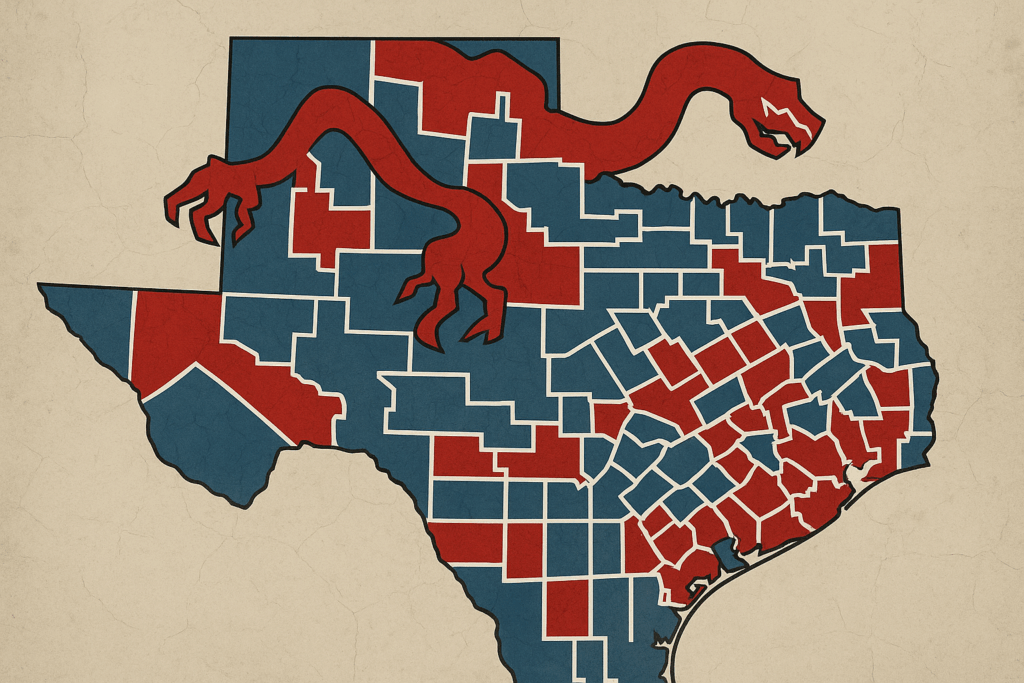
In Texas, the ink is barely dry on the last round of redistricting, and already, Republican lawmakers are racing to redraw congressional maps—again. Backed by President Trump and aimed squarely at diminishing the political power of Latino voters, this latest effort isn’t about retaking control of the U.S. House. They already have it. It’s about cementing their grip before demographic tides wash their majorities away.
And while this is deeply troubling, it’s also—oddly—encouraging. If Republicans were truly confident that their policies and candidates reflected the will of the people, they wouldn’t be scrambling to gerrymander their way to safety. Their desperation is a sign that American democracy, however flawed, still holds enough uncertainty to make power feel precarious. That’s the good news.
The New Map, the Same Old Playbook
The proposed redistricting plan unveiled by Texas Republicans surgically carves up fast-growing, heavily Latino areas to create safer GOP districts. According to The Texas Tribune, the map reduces the number of Hispanic-majority districts and dilutes Latino voting power in areas like the Rio Grande Valley and South Texas—just four years after courts ordered fairer maps for similar reasons.
This time, Republicans are not even pretending this is about fairness or representation. Governor Greg Abbott has threatened to remove Democratic lawmakers from office after they broke quorum and fled the state in protest—an echo of the 2021 voting rights standoff. Meanwhile, Trump has vocally supported the new maps, pushing the narrative that Republican dominance in Texas must be protected at all costs.
When Winning Isn’t Enough
What’s perhaps most revealing about all this is that Republicans aren’t just trying to win—they’re trying to rig the playing field to ensure they can’t lose. And it begs the question: if your political survival depends on silencing voters rather than persuading them, are you still participating in democracy? Or just performing it?
I’ll be blunt: the GOP isn’t doing this because it’s popular. It’s doing it because it’s afraid. Afraid of losing ground with Latino voters. Afraid of rising urban turnout. Afraid that the future doesn’t look like the electorate they’ve long relied on. They’re aware that they don’t have a vision or policies that resonate with the majority, and that reality and actual democracy are both existential threats to their power. And instead of adapting, they’re choosing suppression over evolution.
That’s a stark contrast to how Democrats tend to respond to electoral shifts. As someone who identifies as a Democrat, I can say with confidence that we often accept outcomes we don’t like because we believe the process—the democratic ideal—is more important than the result. That may sound naïve, but it’s also what keeps our system from collapsing under the weight of authoritarian impulses.
The Real Fix: Independent Redistricting for All
This moment should be a wake-up call, not just for Texans, but for every American who cares about representative democracy. Gerrymandering is a bipartisan problem, yes—but it’s most acute in states where one party has unchecked control. The only long-term solution is a Constitutional amendment mandating that all congressional districts be drawn by independent or bipartisan commissions.
These districts should represent actual communities, have equal populations, and resemble squares, not snakes. The process should be transparent, data-driven, and immune to the whims of whichever party happens to be in power. Otherwise, we’ll keep relitigating the same battles every few years—each one leaving voters more cynical and less engaged.
Democracy Isn’t Theatrical—Yet
The fact that Republicans feel the need to resort to these tactics is, ironically, a backhanded compliment to democracy itself. In countries like Russia, North Korea, and Hungary—led by the authoritarian icons Trump seems to admire—elections are mere theater. Outcomes are predetermined. Opponents are silenced or jailed. Power doesn’t transfer—it calcifies.
That’s not where we are. Not yet. But if we don’t push back—if we don’t fight for fair maps, equal representation, and voter access—we could end up with a system where elections exist in name only.
So yes, the Texas GOP’s redistricting scheme is infuriating. But it also signals something hopeful: they know they haven’t won the long game yet. And as long as they feel the need to cheat, it means the rest of us still have a chance to win fairly.